
How a Retail Company Strengthened Its Position in a Fast-Growing Convenience Food Category
Markets are changing faster than ever—once marginal categories are becoming key drivers of growth. In one of our projects, we partnered with a retail company that identified a strong opportunity in a fast-growing fresh convenience meal solutions category and wanted to take a decisive, insight-driven step forward.
The Challenge
The company had an established presence in the category and recognized it as one of its strategic priorities. Global and local trends clearly confirmed its strong growth potential, yet development differed significantly across markets. The company had systematically built its knowledge about the category through internal data analysis, best-practice benchmarking, and customer satisfaction studies. However, the key questions remained unanswered:
How do shoppers experience the category today?
How are their expectations and needs evolving?
How strong is the competition, and what makes it attractive?
Strategy and Objectives
The company’s ambition was to gain a holistic, realistic, and shopper-centric understanding of the category. The primary objective was to support a revision of the marketing strategy, with a strong focus on assortment development, in-store execution, and communication. Specifically, the company wanted to understand better:
- Shopper purchase behavior and decision-making in front of the shelf,
- Expectations across sub-categories,
- Perceptions of competitive offerings,
- Customer characteristics and their dietary habits.
Research Process: » How We Approached the Project «
To address these questions, we designed a multi-phase research approach that combined strategic, tactical, and operational perspectives on the category.
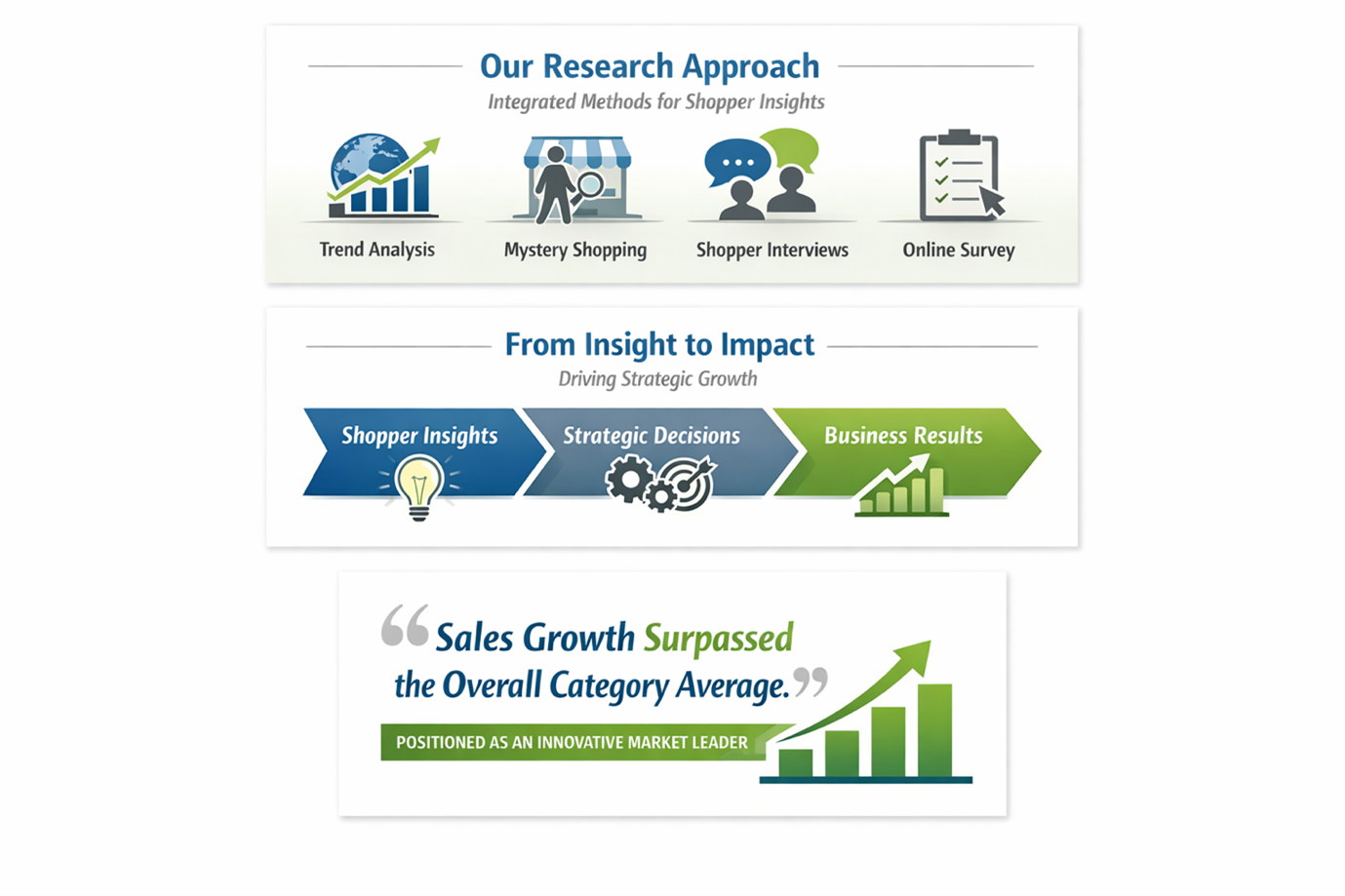
- Global Trend Analysis – We began by analyzing key global and local trends shaping the convenience food category, as well as broader dietary, lifestyle, and consumption patterns shaping consumer expectations.
- Mystery Shopping at the Point of Sale – Enabled a systematic and objective evaluation of product availability and stock levels, visibility, organization, and clarity of the in-store assortment, and consistency of category execution across different store formats and locations.
- In-Store Observation – We observed shoppers during the selection process, tracking how they navigated the department and which elements captured their attention.
- Shopper Interviews – Short in-store interviews provided deeper insight into shopper motivations, preferences, and perceptions of the category, structured around the 4Ps (product, price, place, promotion) and their unmet needs and expectations.
- Online Survey – Finally, an online survey validated qualitative findings at scale and delivered a broader understanding of purchase habits, usage occasions, decision drivers, competitive context, and eating patterns.
Results
Key results included:
- Clear insights into purchase behaviors and perceptions of competitors.
- Identification of the most relevant usage occasions by sub-category.
- Detailed profiles of high-potential shopper segments.
The most significant outcomes were:
- Clear guidelines for developing innovative products and expanding the assortment for selected target groups and customer segments.
- Recommendations for improving in-store organization and execution.
- Ideas for connecting the category to other company activities to create a comprehensive customer approach.
Impact for the Client
Based on the findings, the company:
- optimized its product assortment and developed new offerings,
- successfully engaged with younger and emerging shopper segments.
As a result:
- sales growth surpassed the overall category average,
- and the retailer reinforced its perception as an innovative and relevant player within the category.
Conclusion
This project demonstrated that combining strategic analysis, mystery shopping, and direct shopper interaction provides much deeper and more actionable insights than relying on any single method. Mystery shopping, in particular, proved to be a powerful tool for objectively assessing real-life execution at the point of sale and converting those insights into meaningful improvements.

By Meta Arh, CEO of Temidia & Co-Founder and Partner of Arhea
Developed in collaboration with two sister companies: Arhea, a market research consultancy, and Temidia, a specialist in mystery shopping.